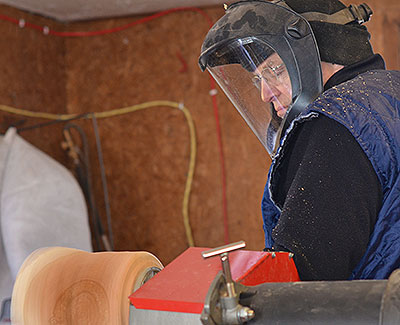
What began as a creative interest in 2017 has become a constant backdrop to everything else I do.
I grew up in Ottawa and moved to Kingston in 1995 for a career. In 2004 I moved to South Frontenac Township. I had always wanted to work with wood and a 3-car garage became a workshop for woodworking, welding and wood turning. As an autodidact, I loved to teach myself new skills.
My woodturning is truly a end-to-end process. Most of the wood I work with is harvested by me from various sources or purchased from specialty providers who harvest themselves. I use only trees that are dead or dying. Typically, I select a tree to harvest by chainsaw, section, prepare, turn, further dry, then turn to form before finishing it with different media including waxes, polyurethanes, shellacs, or lacquers, depending on the piece.
When I began turning, I preferred uniform, clear wood. As my skill level improved, I sought out more challenging woods. Now my preference is spalted or burl wood. Spalting is a discolouration pattern that occurs in wood when it begins to decay. Spalting can occur in both live and dead trees. The discolouration is caused by various bacteria and fungi in the wood's grain. Burls are lumps that grow on tress that are under stress. Often referred to colloquially as "tree cancer," burls have highly sought after grain patterns that are truly one-of-a-kind on their own or provide further creative opportunities.
Spalting and burls provide an opportunity to combine woodturning with the ancient Japanese art and philosophy of Kintsugi. In Kintsugi, damaged pottery and ceramics are repaired with gold or sometimes other substances. In this way, the artist incorporates damage and flaws as design elements that convey the uniqueness of the item. In Kintsugi, the repaired item is seen as more valuable, storied and therefore more unique and intrinsically valuable. Further in the related philosophies, the themes of acceptance of change and fate become relevant. I combine the philosophy of Kintsugi and woodturning with techniques such as metallic layering, metal leafing, staining, airbrushing, tenoning, carving, texturing and other creative techniques to create truly one-of-a-kind pieces.